Showing posts with label Afghan and Blanket Sizes. Show all posts

Monday

My Favorite Free Knit and Crochet Patterns for Blankets


free crochet baby blanket pattern, striped, bobbles

Blackberry Stripe Baby Blanket is worked using 7 colors of Lion Brand Cotton-Ease (1449 total yards). It's based on an easy to learn Bobble Stitch, and links to a how-to video if the stitch is new to you. For the blanket pictured she used 7 different colors of yarn and randomly grabbed a different skein for each row.


Great blanket made up of 24 squares using self-striping sock yarn. Calls for 750 grams of yarn & US 4 needle for a gauge of 23 sts x 46 rows in garter st = 10 x 10 cm / 4'' x 4''. Click on the picture to go to the pattern.

013
Happy Colors Blanket is crocheted following a free tutorial on the Just-do blog.


A cheerful crocheted blanket, Orange Blossom  mixes stripes and flowers in warm summer colors using an H hook and a gauge of 14 dc x 8 rows = 10 x 10 cm / 4'' x 4''.


One of my all time favorite designers, Kaffe Fassett, has posted free instructions to make this patchwork knit
blanket, the Jubilee Throw, using Rowan Felted Tweed DK. It's a very extensive free pattern, written in several languages. But when you scroll to the end it has charts for each of the squares, any one of which could make an interesting cushion or bag. 

"An African Adventure", created by Horst Schulz. It'a on Ravelry so there are lots of different versions for inspiration.

Wednesday

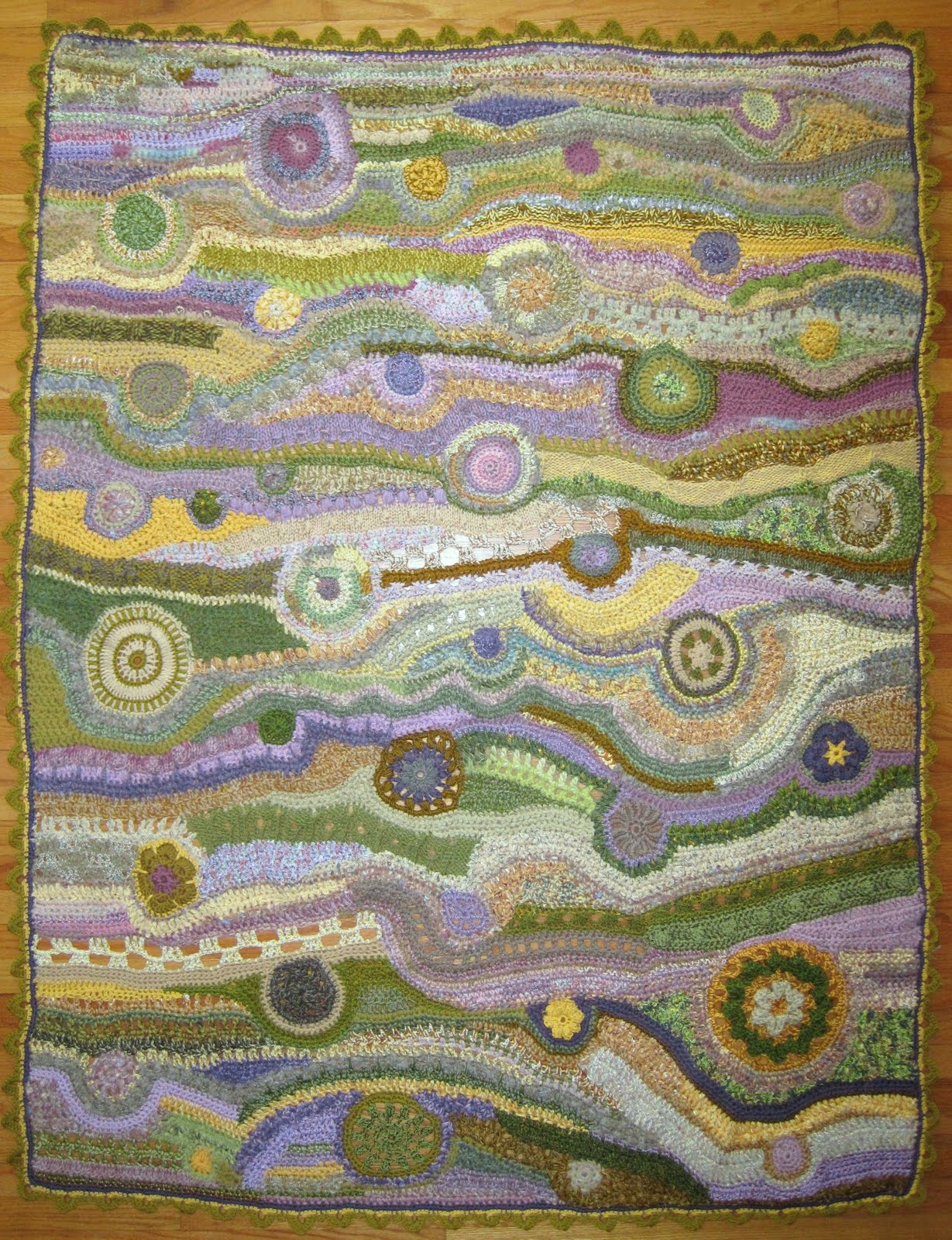
Freeform Afghan - Second Version

Finished! My second attempt at a Freeform Blanket


10/18/10: 
I’m starting a new blanket - trying to do a bit more “controlled” freeform than I have in the past. I’m wanting something that’s a bit calmer and more serene - not quite as tumultuous and busy as the last one. I’m wanting something linear that flows around circular shapes. Usually I cut a piece of fabric in the general shape that I want the piece to end up. This time I made a paper template (I've compiled a list of standard or average blanket and afghan sizes here) so I can draw in where I want the circles and can look at the big picture as I go instead of just randomly putting together shapes that have just sprung forth. (Which I love to do - just wanting to do something different this time.) I guess it could more rightly be called directed freeform.

My color choice is driven by an old Kaffe Fassett pattern featuring multi-yarn triangle shapes that I started about 5 years ago and never finished. I unraveled it, which made some interesting “Magic Balls” that got me started. I made up a bunch of different circle motifs, using patterns from “Beyond the Square, Crochet Motifs” by Edie Eckman. This is without question the book I use more than any other in my library when looking for interesting patterns in inspiring colors with easy to read written instructions and charts. 


Working about 10" ahead at a time I laid out the circles and then crocheted and knitted in stripes across. I drew lines every 10" just to have reference points.
Working towards the first 10" line


I joined my husband at a work conference on the Chesapeake. While he spent his days in meetings I wandered through the nearby towns and as always seems to happen came across some yarn stores. I bought a few yarns that seemed like they'd be perfect.
Yarns from Fibre Cafe in Cambridge, Maryland


Yarns from Yarns & Company in Easton, Maryland


I bought some really beautiful yarns, but some of the colors were really, really off. I cut some pieces of ribbon and attached the yarns onto them by color. I kept these in my handbag & pulled them out whenever a yarn store appeared in my path. It's a great system that's easy to maintain.


10/25/10:
I’ve been struggling to keep this going - not happy with the way it was heading and having trouble figuring out what to do next. On a meander through Ravelry I came across Melisseio’s Free Range Wrap which got me thinking about how I was approaching the whole thing. Between that and a couple of very encouraging Ravelry messages from Jenny Dowde (JenOz on Ravelry) and looking a bit at her work I’m back into a happy mind about where it’s heading. It’s a very different process than I usually use while “freeforming” in that I’ve got a much more specific idea of where I want to end up and how I want the piece to appear. I’m also using colors that are quite out of my usual sphere. Jenny's book, Freeform Knitting and Crochet  is one I often turn to when needing inspriation or a bit of technical direction.


11/8/10


It’s going much more quickly now. Am keeping up with my 10” per week goal - mostly because I’m already planning the next 3 or 4 projects & can’t wait to get this one finished & get onto those. 


almost finished - just need an edging


11/20/10:


The basic shape is finished. It’s feeling like it needs a border. Something sort of wavy so the uneven edges aren’t so noticeable.


12/3/10:


Finished! I decided I needed a border to finish it off. Used #54 from “Around the Corner, Crochet Borders” by Edie Eckman. I modified it slightly - I did 2 base rounds in purple, then did round 1 in yellow and round 2 in green.

This is the other Edie Eckman book that I use constantly. It's got great pictures, and it's easy to modify the instructions to fit the specific edging that you're trying to achieve. 

detail of edging

My "Inspired by Edie Eckman's Beyond The Square" Afghan

I used Edie Eckman's book, "Beyond the Square" crochet motif guidebook to make circles for my freeform afghan and enjoyed the square making process so much I've decided to make one of each of the motifs in the book and somehow put it together into an afghan.


Monday

How to Figure How Many Granny Squares You Need For an Afghan

There are a number of things you need to keep in mind when figuring how many squares you'll need to make an afghan or blanket.


1. Make several squares in the pattern you've chosen.

2. Block and measure the squares. Blocking is especially important when assembling a blanket out of squares. It's one of the few times I actually block my work. The time and headache saved in assembly more than makes up for what you spend blocking. I have photos and written instructions on the process I follow here.

3. Decide how you're going to assemble your squares. The assembly method you choose will affect the finished size of your blanket. Whipstitching or single crocheting the blocks together won't afect the size much. But joining with a decorative stitch can affect the outcome. Even just a 1/4" added on a join can add 4 - 5" to the overall size of a king blanket using 4" squares. So if you're choosing something fancy like that you're going to have to piece a few together to figure out what the size is of your blocked, assembled square.

4. Divide the length and width of the blanket you want  (I've compiled a list of standard blanket & bedding sizes here) to make by the size of your finished squares (including whatever you added for assembly).
This probably won't be a round number, so you'll have to decide whether you want to round up and make a slightly larger blanket, or round down and make a slightly smaller blanket. (Keep in mind that if you round down you can add a decorative border.) Then multiply the number of squares you need across by the number of squares you need for the length and you'll have the total number of squares you'll need to make.

As a formula it would look like this for a 48" x 60" throw made out of 5" squares:
48"/5"=9.6" so round up to 10.
60/5=12.
10 x 12=120.
So you'd end up making 120 squares and your blanket would be done in rows of 10 squares. And you'd have 12 rows.
Final finished size would be 50" x 50".

My 3 favorite books filled with Granny Square Patterns:

I've spent a lot of time poking around the web looking for free granny square patterns. Keeping track of them is sort of a nightmare. Not only are the patterns written in each persons own "shorthand", but the photos are uneven & it's a hassle to print them out & keep them in any sort of organized fashion that allows me to find what I want when I want it. While browsing in the bookstore I bought just about every book I could find on the subject. Here are my favorites. I highly recommend them to your library!


Thursday

Afghan & Blanket Sizes

November 2, 2014: When I published this list back in March of 2008 the world was a different place! Today there are much easier ways to create graphic content that is easily downloaded and I've gained a few years experience with Photoshop & Illustrator. As I scrolled through this page for the umpteenth time looking for a mattress size for a new project, I decided to spend some time creating an infographic that I could pin up in my workroom. 

That ended up being a much bigger project than I would have imagined! I ended up re-researching all the sizes and did find some changes in 6 years. So here's what I've come up with:
a list of popular U.S. afghan and blanket sizes for babies, kids and adults
Downloadable graphic of popular U.S. mattress, blanket, comforter and afghan sizes


If you'd like to save it to your computer or print it and pin it in your workspace you can download a printable pdf file here. And if you'd like to see what I've been up to in my new life as a surface and pattern designer check out my new blog.

Now that you've figured out what size to make your quilts you still need to figure out how much fabric to buy. Here are my favorite books to help with that process: 


And I also found this great system to hang quilts on a wall:
  

And here's my original post from March 6, 2008 (exactly 65,543 visits ago!):

In trying to figure out what size I ultimately wanted my Babette Blanket to be I did some research on standard mattress, sheet, blanket & comforter sizes. I know I've done this before but I can't find the papers so I'll put it here so I can find it again. Flat sheet measurements are from bedding industry standards. Everything else is sort of an average that seems about right. Crib blankets & receiving blankets seem to have the biggest variances - there's pretty much every size possible available. I listed the most prevalent.

Mattress depths vary widely be manufacturer. Measure the depth of the mattress before designing the blanket/quilt/comforter. Standard & older mattresses average 9 - 12", while newer pillow-top mattresses are 14 - 16" deep and up. These deeper mattresses obviously rquire more depth & width to cover the mattress completely. Be especially careful about making covers for very fluffy comforters such as down-filled. They tend to puff out the fabric, so there is much more area to cover than the dimensions listed on the package. Take several measurements of the comforter after it has been fluffed to decide how big to make the cover.


If you're making a blanket using squares, in addition to figuring out what size you want you'll need to calculate how many squares to make. I've written up notes on the process I use to figure out how many granny squares you need here.

TWIN: mattress top is 39" x 75"
Twin flat sheet: 66" x 96"
Twin Blanket: 66" x 90"
Twin Comforter: 69" x 90"

EXTRA LONG TWIN: mattress top is 39" x 80" ** Most popular size in college dorms
Extra Long Twin Flat Sheet: 66" x 102"
Extra Long Twin Blanket: 66" x 95"

FULL/DOUBLE: mattress top is 54" x 75"
Full/Double Flat Sheet: 81" x 96"
Blanket: 80" x 90"
Full Comforter: 84" x 90"

QUEEN: mattress top is 60" x 80"
Queen Flat Sheet: 90" x 102"
Blanket: 90" x 100"
Queen Comforter: 90" x 95"

KING: mattress top is 76" x 80"
King Flat Sheet: 108" x 102"
Blanket: 108" x 100"
King Comforter: 106" x 98"

CALIFORNIA KING: mattress top is 72" x 84"
California King Flat Sheet: 102" x 110"
Blanket: 104" x 108"

INFANTS & TODDLERS:
Receiving Blanket*: 
23" x 23", 24" x 24", 29" x 32", 30" x 36" or 36" x 36"
Stroller Blanket: 30" x 40"
Porta Crib (mattress top is 24" x 38") use receiving blanket
Small Cradle Blanket (mattress is 15" x 33") 15" x 30"
Large Cradle Blanket (mattress is 18" x 36") 18" x 33"
Crib Blanket(mattress top is 28" x 52"): 28" x 42" or 30" x 40" or 36" x 42" or 36" x 46"

AFGHAN SIZES

Infant - 2 years: 24" x 30"
2 - 6 years: 30" x 36"
7 - 11 years: 36" x 42"
12 years and over: 48" x 60"

Lapghan: 36"x 48" often used in nursing homes & wheelchairs
Adult: 50" x 70"

BED PILLOW SIZES
Standard 20" x 26"
Queen 20" x 30"
King 20" x 36"


* Receiving Blankets: I've seen lots of discussion on receiving blankets. Most people seem to think 23 or 24 inch squares are perfect for newborns, as there isn't too much fabric to manage. 29" x 32", 30" x 36" or 36" x 36" are the sizes most often made by manufacturers that are available in stores.

"Janem" also provided the following helpful info: Bev’s Country Cottage website gives suggestions for different size blankets.

This is basically what she recommends….
Blanket Sizes (approximate) For preemies, blankets without ‘holes’ are best.
Small Preemie: 18” - 20” square
Medium Preemie: 20” - 22” square
Large Preemie: 22” - 28” square
Full Term Baby: 28” - 36” square
Baby 30” x 36” = crib sized (6” granny squares= 5 across x 6 down ~ 30 sq)
Children 42”x 48” (6” squares= 7 across x 8 down ~ 30 sq)
Lapghan often used in seniors homes 36” x 48” (6” squares= 6 across x 8 down ~ 48 squares)
Adult Afghan (Will fit across top of bed) 48” x 72” = twin sized. (6” squares= 8 across x 12 down ~ 96 squares)
Adult Double Bed (Will fit across top of bed) 60” x 84” = full sized. (6” squares= 10 across x 14 down ~ 160 squares)


Please post a comment if you have suggestions or real-life experience with any of this!

Shantel R M brought up a great point in the comments below. If you're not happy with the size of a project when you've finished you can always add a border. I think the crochet book I turn to the most is:
I highly recommend it as a book you'll turn to time and time again.

Print Friendly and PDF

Monday

Garter Stripe Baby Blanket


Garter Stripe Baby Blanket

Plymouth Encore DK: 1 skein each of 13 colors*
Size 5 circular needle.

I used the "Kiss My Shadow" online stripe generator to come up with the pattern, limited to 1, 2 or 3 row stripe widths. It's a fun toy to play around with - I did it quite a few times until I found a version I liked.

From there its was easy:

Cast on 140.

Knit in garter stitch following stripe pattern to desired length. Mine ended up being 30" wide by 36" long. (See my notes and a list of average blanket sizes if you want to make a blanket or afghan for a child or adult.)

I'm not a big fan of acrylic, but I know moms like it because it's machine washable, and I was looking for something that came in a lot of colors and was relatively inexpensive. The Encore, at 75% acrylic & 25% wool wasn't quite as soft & cuddly as pure wool would be - but it was considerable cheaper and should be easy to care for. The color selection is fantastic. I chose strong bright colors - but it also comes in baby pastels.

The benefit of the garter stitch stripe is that the blanket is interesting from both sides.


*13 colors I used: 4379 (Celery). 1304 (Seafoam) . 999 (Burgundy). 848 (Navy). 9601 (Red). 1382 (Yellow).217 (Black). 515 (Wedgewood Blue). 233 (Lavender). 1384 (Purple). 1385 (Hot Pink). 1383 (Orange). 1317 (Teal)